Your Fairness Cream Might Be Wrecking Your Skin: The Hidden Steroid Problem
A patient walks into my clinic almost every week with the same story. A friend, a relative or the local pharmacy suggested a cream. Within a fortnight her skin looked brighter and her pimples had settled. She was thrilled.
Then, a few months later, the glow turned into redness. Her face burned in the sun. Pimples came back in crops, and fine hair appeared on her cheeks. Each time she stopped the cream, her skin flared up, so she went back to it.
She did not have bad skin. She had a steroid problem, and she did not know it.
What Is Really in That Tube
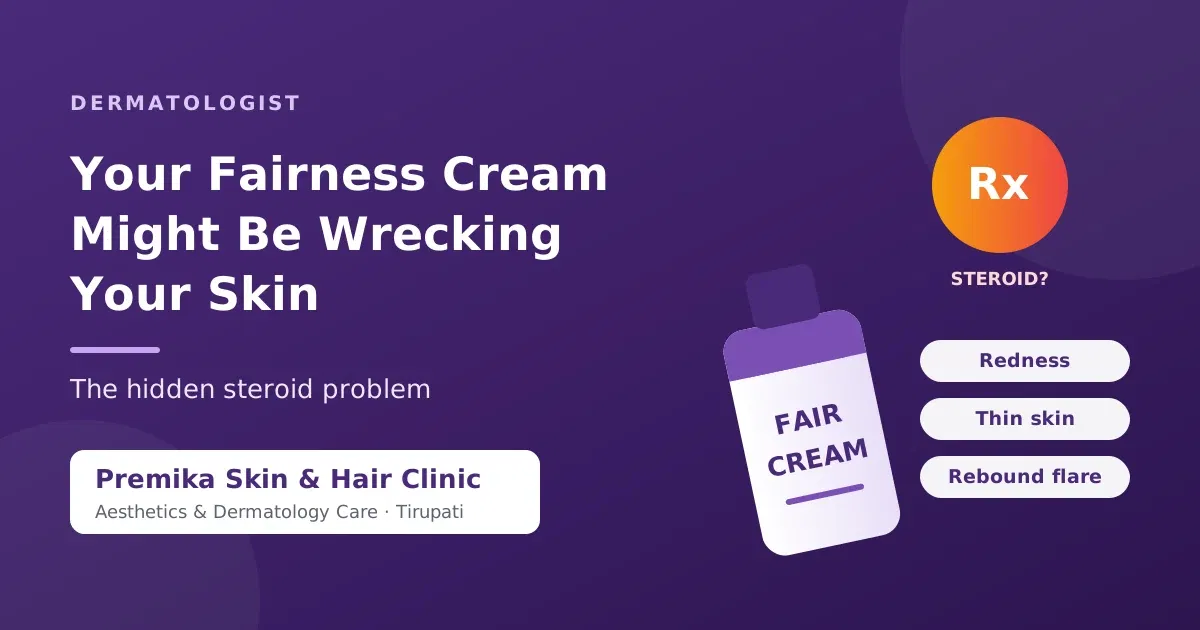
Many creams used for "fairness" in India contain a potent topical steroid. Some are prescription medicines being used the wrong way. Others are unlabelled or locally mixed creams that do not declare a steroid at all.
The usual culprits are:
- Steroid-only creams such as betamethasone, clobetasol and mometasone, meant for short courses in eczema or psoriasis.
- Triple-combination creams that mix a steroid with hydroquinone and tretinoin. These are meant for melasma, for a few weeks, under a doctor's supervision. See our guide on melasma vs other pigmentation.
- Mixed "all-in-one" creams that combine a steroid with an antifungal and an antibiotic, often applied on the face for any rash or dark patch.
- Unbranded or salon creams sold without a full ingredient list.
These are medicines, not cosmetics. Topical steroids are prescription-only drugs in India, yet they are still easy to buy over the counter. A steroid is a useful medicine in the right dose, on the right skin, for the right number of days. On the face, for months, it is a different story.
Why It Works at First, and Then Turns on You
Steroids calm inflammation and narrow the tiny blood vessels in the skin. Redness fades, pimples flatten and the face looks lighter and smoother. That early result is what makes these creams so popular.
The effect is temporary, and the cost builds quietly. With continued use, the steroid thins the skin, weakens its natural barrier and makes blood vessels fragile. The skin also starts to depend on the cream. When you stop, the vessels widen again and the face flares up worse than before. Most people read this as proof that they need the cream, and the cycle continues.
Dermatologists call the result topical steroid damaged face. Facial skin is thin and absorbs medicine easily, so it is the first place to suffer.
Warning Signs to Look For
If you have used a fairness or "face clearing" cream for more than a few weeks, check for these:
- Persistent redness, or a face that flushes easily
- Burning, stinging or itching, especially in sunlight or after washing
- Pimples or small red bumps that keep returning
- Visible thin red veins on the cheeks or nose
- Thin, shiny or easily irritated skin
- New or thicker facial hair
- Patchy darkening or lightening of the skin
- A flare-up within days of stopping the cream
The last sign is the most telling. Healthy skin does not punish you for stopping a cosmetic.
How to Check Your Cream
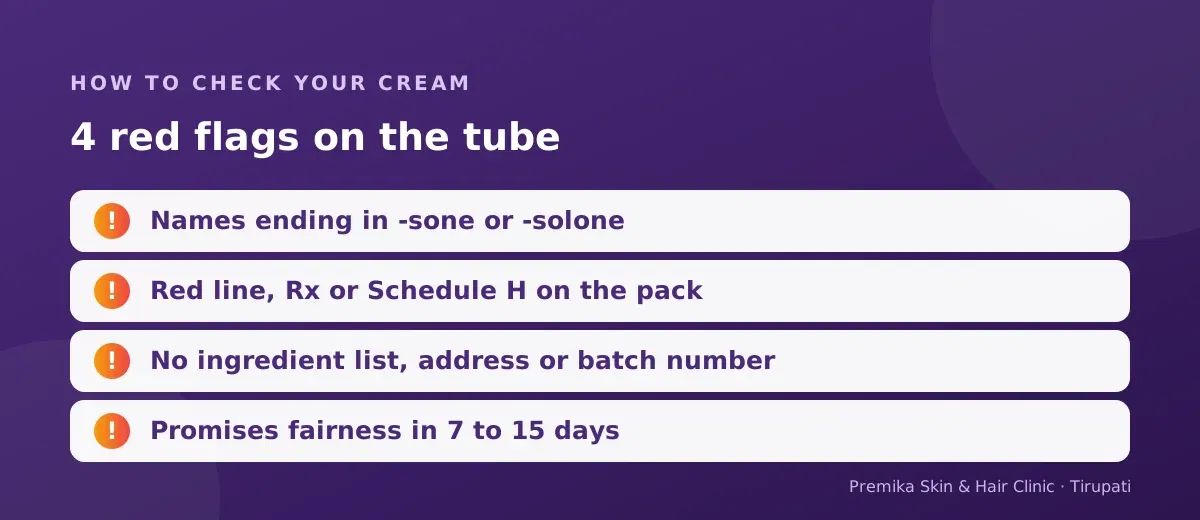
Turn the tube over and read the composition. Take it seriously if you see:
- Names ending in -sone or -solone, or the words clobetasol, betamethasone, mometasone, fluocinolone or fluticasone
- A red line or "Rx" on the pack, or the words "Schedule H" or "to be sold on prescription only"
- No ingredient list, no manufacturer address or no batch number
- A cream that was mixed, repacked or sold loose
- A promise of visible fairness in 7 to 15 days
If you cannot tell, bring the tube to your dermatologist. It takes us a minute to check.
If You Are Already Using One
Do not panic, and do not stop abruptly on your own. After long use, sudden withdrawal can cause a severe flare of redness, burning and swelling.
- See a dermatologist and carry every cream you have used.
- Follow a planned withdrawal. We usually taper the steroid and support the skin with gentle, non-steroid treatment.
- Keep your routine simple: a mild cleanser, a plain moisturiser and a broad-spectrum sunscreen. Our guide on how to choose the right sunscreen can help.
- Avoid scrubs, bleach, facials, home remedies and new actives until the skin settles.
- Be patient. Recovery often takes weeks to months, depending on how long the cream was used.
Most of the damage improves with the right care. The earlier you come in, the easier it is to reverse.
A Safer Way to Brighter Skin
What most people want is not a different colour. They want even, clear, healthy skin. That is achievable without steroids.
- Daily sunscreen is the single most effective step against tanning and dark patches.
- Proven non-steroid ingredients such as vitamin C, niacinamide, azelaic acid and kojic acid help with pigmentation when chosen for your skin type.
- A diagnosis first. Melasma, post-acne marks, tanning and hormonal pigmentation each need different treatment. Read more about pigmentation treatment.
- Clinic procedures such as chemical peels and lasers can help selected patients, when done by a qualified dermatologist.
Your natural skin tone is not a disease and does not need a cure. Skin that is healthy will always look better than skin that has been bleached into trouble.
Unsure about a cream at home?
If this post sounds like your story, bring your cream along to Premika Skin & Hair Clinic, Tirupati. We will check it and plan a safe way forward.
Book a Consultation Call 80882 61834This article is for general awareness and is not a substitute for a personal consultation.