
How to Choose the Right Sunscreen for Your Skin
Sunscreen is the single most effective product for preventing tanning, pigmentation and early ageing, yet most people either pick the wrong one or stop using it because it feels heavy, greasy or leaves a white cast.
The right sunscreen is one that protects well, suits your skin type and feels comfortable enough to wear every day. Here is how to find it. If you are already dealing with dark patches, read our guide on melasma vs other pigmentation or see pigmentation treatment in Tirupati.
What to Look for on the Label
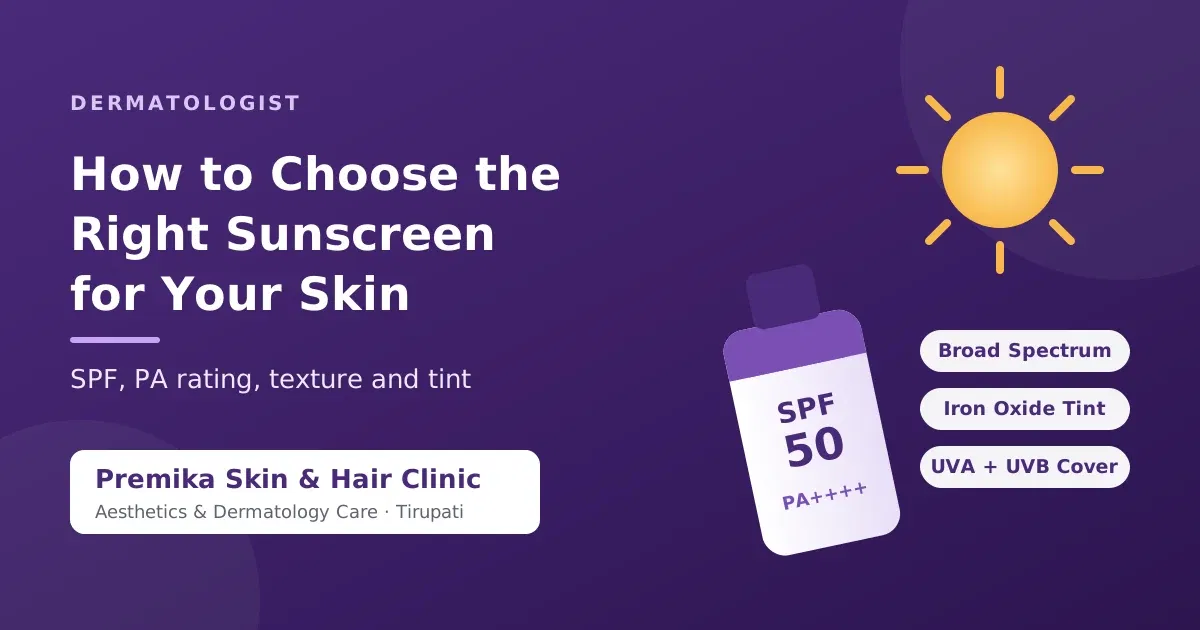
SPF 30 or higher. SPF measures protection against UVB rays, which cause sunburn and tanning. SPF 30 is enough for daily use. Choose SPF 50 if you spend long hours outdoors or are being treated for pigmentation.
Broad spectrum. This means the sunscreen also protects against UVA rays, which go deeper, pass through window glass, and cause pigmentation and ageing.
PA+++ or PA++++. The PA rating shows the level of UVA protection. More plus signs mean more protection.
Tint with iron oxide. Visible light, including daylight indoors, can darken melasma and other pigmentation. Regular sunscreens do not block it, but tinted sunscreens containing iron oxide do.
Water resistant. Needed for swimming, sports or heavy sweating. The label states 40 or 80 minutes of resistance.
Mineral or Chemical: Which Is Better?
Both protect well when used correctly. The difference is in how they feel and who they suit.
Mineral (physical) sunscreens contain zinc oxide or titanium dioxide. They are gentle and rarely irritate, so they suit sensitive skin, children, pregnancy and skin recovering from procedures. Older formulas leave a white cast, though tinted versions solve this.
Chemical (organic) sunscreens contain filters such as avobenzone, octocrylene or newer ones like Tinosorb and Uvinul. They are lightweight, spread easily and leave no white cast, which makes them comfortable for daily wear. A few people with sensitive skin may feel stinging.
Hybrid sunscreens combine both and offer high protection with a lighter feel.
Choose by Skin Type
| Skin type | Best texture | Look for | Avoid |
|---|---|---|---|
| Oily or acne-prone | Gel, fluid or matte lotion | Non-comedogenic, oil-free | Thick, greasy creams |
| Dry | Cream or rich lotion | Ceramides, glycerin, hyaluronic acid | Alcohol-heavy gels |
| Combination | Lightweight lotion or gel-cream | Non-comedogenic, light finish | Very rich creams on the T-zone |
| Sensitive | Mineral cream or lotion | Zinc oxide, fragrance-free, alcohol-free | Fragrance, essential oils |
| Pigmentation or melasma | Tinted sunscreen | SPF 50, PA++++, iron oxide | Untinted sunscreen alone |
← Swipe to see the full table →
Choose by Lifestyle
- Mostly indoors: SPF 30 with good UVA cover is enough. Apply it in the morning and again before stepping out.
- Outdoor work, travel or sports: SPF 50, water resistant, with a hat or umbrella.
- Swimming: water-resistant sunscreen, reapplied after every swim.
- Wearing makeup: apply sunscreen under makeup, then reapply with a sunscreen stick, powder or spray.
- Children: mineral sunscreens from 6 months of age. Babies under 6 months should be kept in shade and covered clothing. See our pediatric dermatology page for child skin care.
- Pregnancy: mineral sunscreens are the usual first choice, and daily use helps prevent pregnancy-related melasma.
- After peels, lasers or other procedures: gentle mineral sunscreen, as advised by your dermatologist. Learn more about chemical peels and laser treatments.
How to Apply It Correctly
Even the best sunscreen fails if too little is used. Most people apply less than half the amount needed.
- Apply it as the last step of your morning skincare, after moisturiser and before makeup.
- Use two finger-lengths of product for the face and neck.
- Apply 15 to 20 minutes before going out.
- Cover the ears, the back of the neck, hands and feet if exposed.
- Reapply every 2 to 3 hours outdoors, and right after swimming or sweating.
- Use it every day, including cloudy days and days spent indoors near windows.
Common Myths
"Dark skin does not need sunscreen." Darker skin burns less easily, but it tans and develops pigmentation more readily. Sunscreen is essential for Indian skin.
"I do not need it on cloudy days or indoors." UVA rays pass through clouds and window glass all year round.
"SPF 100 is twice as good as SPF 50." SPF 30 blocks about 97% of UVB and SPF 50 about 98%. Applying enough and reapplying matters more than a very high number.
"The SPF in my makeup or moisturiser is enough." You would need a much thicker layer than anyone actually applies. Use a separate sunscreen.
"Sunscreen causes vitamin D deficiency." Normal daily use does not cause deficiency in most people. If your levels are low, diet and supplements are safer than unprotected sun exposure.
"Sunscreen causes pimples." The wrong texture can. A non-comedogenic gel or fluid suits acne-prone skin well.
The Takeaway
Choose a broad-spectrum sunscreen of SPF 30 or higher with a high PA rating, in a texture that suits your skin type, and use enough of it every day. If you have melasma or pigmentation, pick a tinted one.
Not sure which sunscreen suits you?
If you have acne, sensitive skin, pigmentation, or have reacted to sunscreens before, a dermatologist can recommend one that fits your skin. Book a consultation at Premika Skin & Hair Clinic, Tirupati, for personalised advice.
Book a Consultation Call 80882 61834This article is for general awareness and does not replace a consultation with a dermatologist.