
What Really Happens During a Chemical Peel
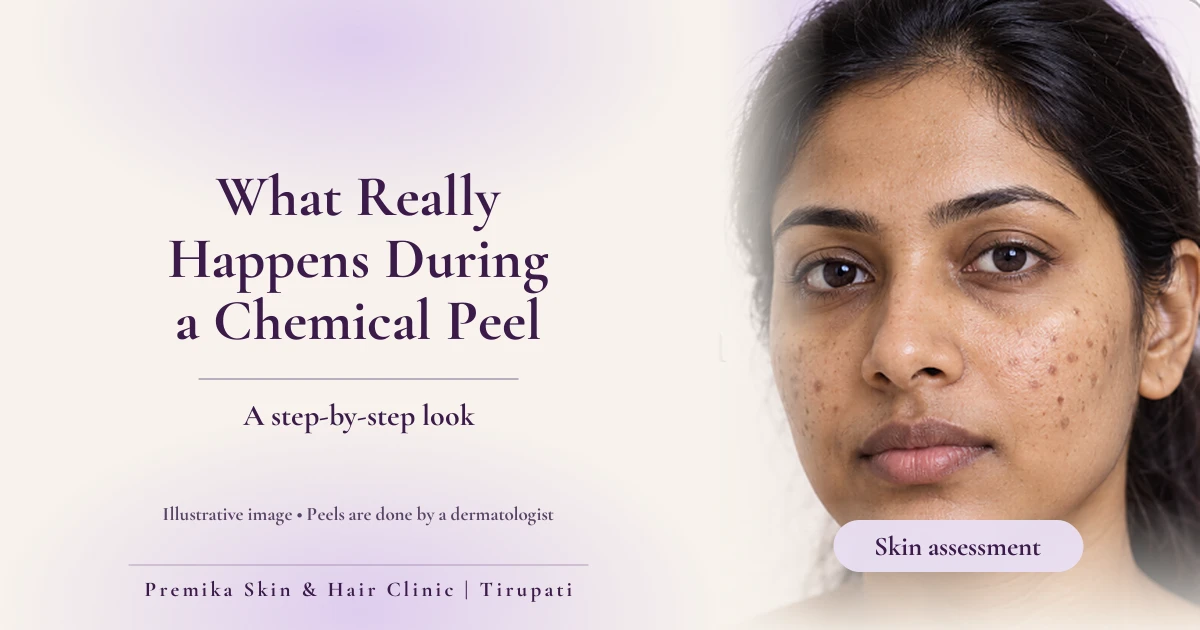
A chemical peel is a controlled exfoliation: a measured acid solution loosens the damaged top layers of skin so that fresher, more even skin replaces them. Most peels take under 30 minutes, tingle for a few minutes, and cause far less visible peeling than the name suggests.
You can read more about the peels we offer on our chemical peels in Tirupati page.
First, What a Peel Actually Is
The word "chemical" worries people, and "peel" worries them more. Many patients arrive expecting their face to come off in sheets. It does not.
Your skin sheds dead cells every day. With age, sun, acne and pigmentation, that shedding slows and becomes uneven, so skin looks dull and patchy. A peel speeds the process up in a controlled way. The acids used are familiar ones: glycolic acid from sugarcane, lactic acid from milk, salicylic acid, mandelic acid.
Dermatologists use peels for:
- Active acne and clogged pores
- Dark marks left behind by pimples
- Tanning, dullness and uneven tone
- Melasma and other pigmentation, as part of a wider plan. See melasma vs other pigmentation.
- Fine lines and rough texture, as part of anti-ageing care
Not All Peels Are the Same
Peels are grouped by how deep they reach. The depth decides the result, the downtime and the risk.
| Type | How deep | Common agents | Downtime |
|---|---|---|---|
| Superficial | Outermost layer only | Glycolic, lactic, salicylic, mandelic acid | None to 3 days of mild flaking |
| Medium | Into the upper part of the deeper layer | Trichloroacetic acid (TCA) | About a week of visible peeling |
| Deep | Well into the deeper layer | Phenol | Weeks; rarely used today |
← Swipe to see the full table →
Most peels done in Indian clinics are superficial. Our skin tones pigment easily when irritated, so gentle peels repeated over several sessions are safer and work better than one aggressive peel.
In the Clinic, Step by Step
The whole visit usually takes 20 to 30 minutes.
- Consultation. Your dermatologist examines your skin, asks about medicines, allergies and cold sores, and chooses the peel and its strength. You may be asked to use a priming cream and sunscreen for two weeks beforehand.
- Cleansing. Your face is cleaned and degreased so the peel spreads evenly.
- Protection. Petroleum jelly goes on the corners of the eyes, nose and lips, where skin is thin.
- Application. The solution is applied with a brush or gauze, one area at a time. Expect tingling, warmth or mild stinging for a few minutes. A small fan helps.
- Watching the clock. The peel stays on for a set time, usually 2 to 5 minutes. Your doctor watches the skin throughout and removes it early if needed.
- Neutralising. The peel is neutralised or washed off, and the stinging settles quickly.
- Soothing. A calming moisturiser and sunscreen are applied, and you go home with written aftercare.
You can return to work or college the same day after a superficial peel.
The Days After
After a superficial peel, most people see this pattern:
- Day 1. Mild redness and tightness, like a light sunburn.
- Days 2 to 4. Dryness and fine flaking, mostly around the mouth and chin. Some people do not flake at all, and the peel has still worked.
- Days 5 to 7. Flaking settles. Skin looks brighter and feels smoother.
Peels work gradually. Most concerns need 4 to 6 sessions, spaced 2 to 4 weeks apart.
Aftercare decides the result as much as the peel does
- Wear sunscreen every morning and reapply it outdoors. Freshly peeled skin tans and pigments very easily. See how to choose the right sunscreen.
- Moisturise generously with a plain, fragrance-free product.
- Do not pick, scrub or pull off flaking skin. This is the main cause of marks after a peel.
- Wash with a gentle cleanser and cool water.
- Pause retinoids, scrubs, face acids, bleaching, waxing and threading until your doctor says to restart.
- Avoid steam, sauna, swimming and heavy workouts for two to three days.
Call your doctor if you notice blisters, crusting, severe burning, swelling or a dark patch.
Who Should Wait
A peel may need to be postponed or avoided if you:
- Have an active cold sore, skin infection, open wound or sunburn on the face
- Took oral isotretinoin recently
- Are pregnant or breastfeeding (some peels are unsuitable; ask your doctor)
- Tend to form keloids or thick scars
- Cannot avoid strong sun in the following week
- Recently waxed, threaded or bleached the area
Three Myths Worth Dropping
"Peels thin the skin." They remove dead surface cells. Repeated superficial peels are associated with better collagen, not thinner skin.
"If I do not peel, it did not work." Visible flaking depends on the acid and your skin. Results come from what happens in the skin, not what falls off it.
"A peel at home or in a salon is the same thing." Strength, timing and neutralising are medical decisions. Peels done without that judgment are a common cause of burns and stubborn pigmentation.
The Bottom Line
A chemical peel is a short, well-understood procedure, not a dramatic one. Done by a dermatologist, at the right strength for your skin, and followed by careful sun protection, it is one of the safest ways to treat acne marks, tan and dullness.
Thinking about a peel?
Book a consultation at Premika Skin & Hair Clinic, Tirupati, and find out which peel suits your skin. Read more about our chemical peels.
Book a Consultation Call 80882 61834This article is for general awareness and is not a substitute for a personal consultation.