
Why Your Dandruff Keeps Coming Back
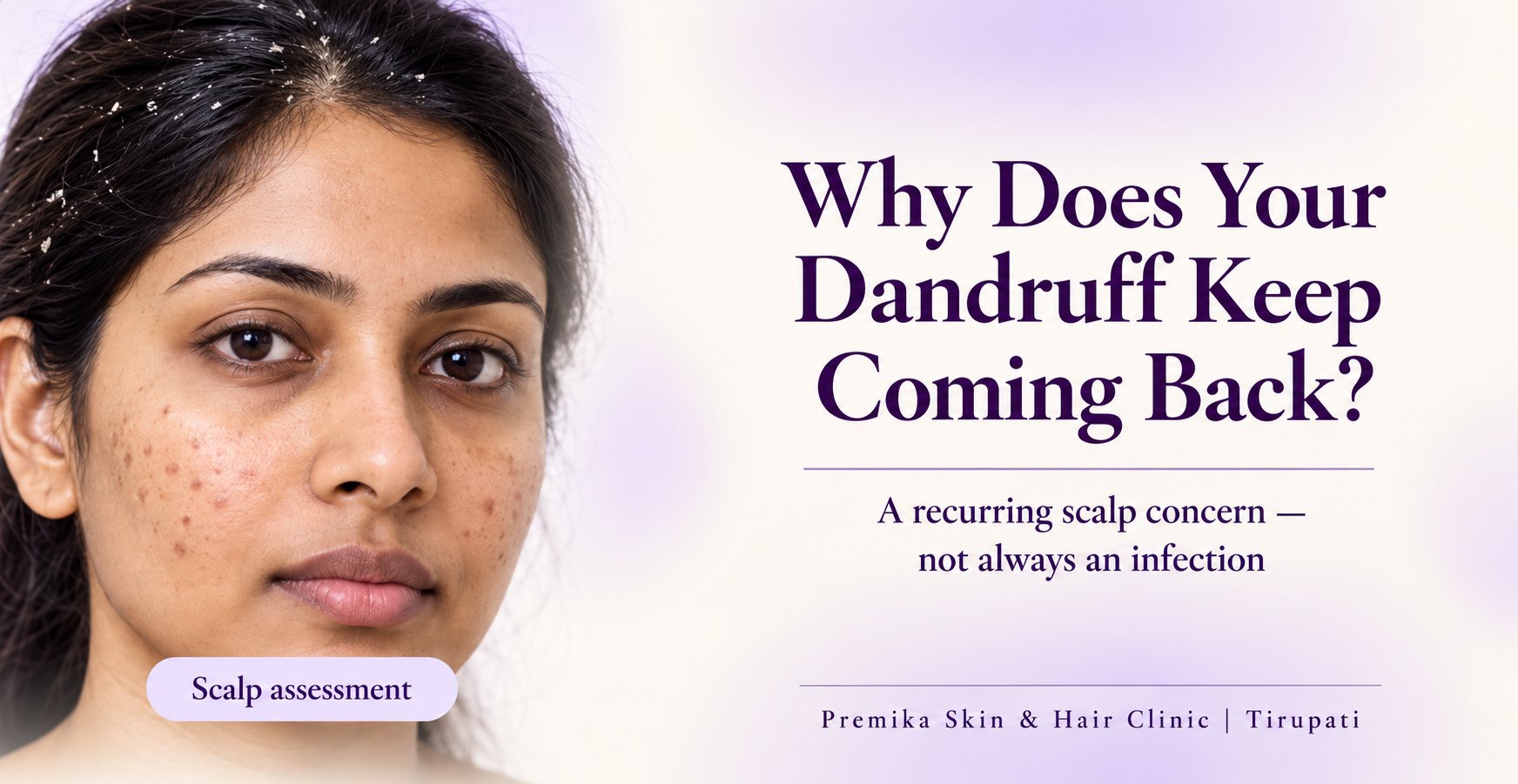
Dandruff comes back because it is a long-term scalp tendency, not a one-time infection. Shampoos control it; they do not cure it.
You know the pattern. You buy an anti-dandruff shampoo, the flakes vanish in two weeks, you stop, and a month later your shoulders are dusted white again. That is not the shampoo failing. It is how dandruff behaves, and once you understand why, it becomes far easier to keep under control. You can also read about hair and scalp care in Tirupati.
What Dandruff Actually Is
Dandruff is your scalp reacting to a yeast that lives on everyone's skin. The yeast, called Malassezia, feeds on scalp oil and leaves behind by-products that irritate some people more than others.
In a sensitive scalp, that irritation speeds up skin cell turnover. Cells shed in visible clumps instead of invisibly, and you see flakes, often with itching.
Three things have to be present: the yeast, the oil, and a scalp that reacts to them. You cannot remove any of the three permanently, which is why dandruff is managed rather than cured. It is not contagious and it is not a sign of poor hygiene.
7 Reasons It Keeps Coming Back
- You stop the shampoo once the flakes clear. The yeast regrows within weeks. Most people need a maintenance wash once a week or once a fortnight, even when the scalp looks fine.
- You rinse it off too fast. Medicated shampoo needs 3 to 5 minutes of contact with the scalp to work. Lather, wait, then rinse.
- You are washing the hair, not the scalp. The problem is on the skin. Work the shampoo into the scalp with your fingertips, not your nails.
- You oil a flaky scalp. Flakes look like dryness, so oiling feels logical. But the yeast feeds on oil, and leaving oil on overnight often makes dandruff worse.
- You wash too rarely. Oil, sweat and dead skin build up between washes. In hot, humid weather, or if you sweat a lot or wear a helmet daily, the scalp needs more frequent washing. Hard borewell water can also leave the scalp dry and itchy; see hard water and hair fall.
- Your triggers are still active. Stress, poor sleep, illness, seasonal change and heavy styling products can all set off a flare. Read more in Gen Z and hair loss.
- Your scalp has got used to one routine. If a shampoo that once worked seems weaker, alternating between two different active ingredients often helps.
When It Is Not Dandruff at All
Some stubborn "dandruff" is a different condition, and no dandruff shampoo will fix it. These are the common look-alikes.
| Condition | What you notice |
|---|---|
| Seborrheic dermatitis | Greasy yellowish scales with redness; may also affect eyebrows, sides of the nose and behind the ears |
| Scalp psoriasis | Thick, silvery, well-defined patches, often extending past the hairline |
| Fungal infection (tinea capitis) | Scaly patches with broken hairs or hair loss; more common in children |
| Contact dermatitis | Itching and scaling after a new hair dye, oil or shampoo |
| Dry scalp | Small, fine, dry flakes with a tight feeling and no greasiness |
← Swipe to see the full table →
Each of these needs a different treatment, so the right diagnosis matters more than the next shampoo. See our general dermatology page for scalp and skin conditions.
What Actually Keeps It Away
Long-term control comes from a simple routine followed consistently, not from a stronger product.
- Use the right active ingredient. Look for ketoconazole, zinc pyrithione, selenium sulfide, ciclopirox or salicylic acid on the label.
- Treat first, then maintain. Use the medicated shampoo two or three times a week until the scalp settles, usually 2 to 4 weeks. Then drop to once a week or fortnight to keep it settled.
- Give it contact time. Leave the lather on the scalp for 3 to 5 minutes before rinsing.
- Use a mild shampoo on other days. Condition the lengths only, not the scalp.
- Keep oil short. If you like oiling, apply it for an hour before a wash rather than overnight.
- Wash after heavy sweating, and keep helmets, combs and pillow covers clean.
- Look after the basics. Sleep, stress and a balanced diet all show up on the scalp.
When to See a Dermatologist
Book a consultation if any of these apply:
- No improvement after 4 weeks of correct, regular use of a medicated shampoo
- Redness, thick crusts, oozing or pain on the scalp
- Flaking on the face, eyebrows, ears or chest
- Hair fall or bald patches along with the scaling
- Intense itching that disturbs sleep
- Scaling in a child. See our pediatric dermatology page.
A dermatologist can confirm what is actually causing the flakes and prescribe treatment that shampoos alone cannot give, such as medicated lotions or short courses of anti-inflammatory scalp applications.
The Bottom Line
Dandruff that keeps returning is common and very manageable.
Dandruff that will not settle?
If yours has not settled despite your best efforts, visit Premika Skin & Hair Clinic, Tirupati, for a scalp assessment and a routine built for your scalp.
Book a Consultation Call 80882 61834This article is for general awareness and is not a substitute for a medical consultation.