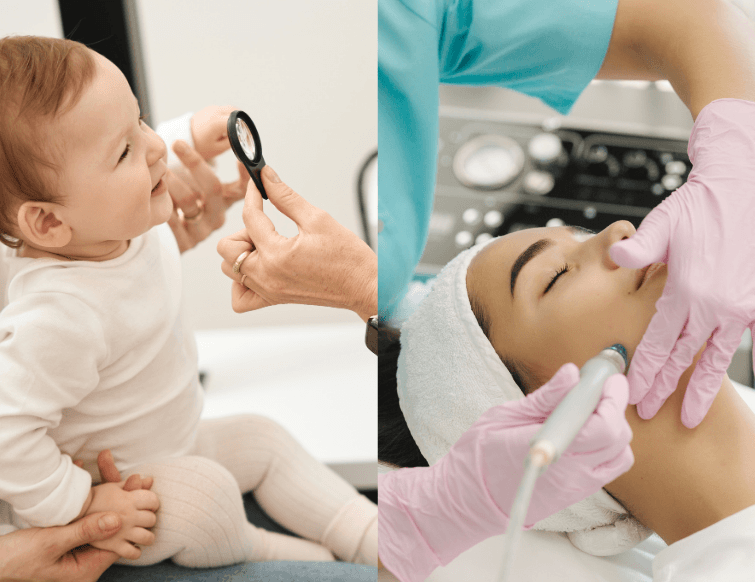
Children's skin is more delicate and sensitive than adult skin, requiring specialised care approaches. Women's skin, meanwhile, undergoes unique changes throughout their lifespan due to hormonal transitions—from puberty and menstruation to pregnancy and menopause. The intricate Neuro-Immuno-Cutaneous-Endocrine (NICE) network connects hormones, immune signals, and nerve signals within the skin, meaning hormonal shifts can significantly impact skin health and trigger or worsen various conditions.
Dr M S Premika, an experienced Aesthetic Dermatologist with MBBS and DDVL qualifications and 10 years of overall experience, provides expert, compassionate care for both children and women at her clinic in Korlagunta, Tirupati.
Causes: Eczema is a chronic inflammatory skin condition marked by intense itching. It most commonly begins between 3 and 6 months of age, with 90% of children diagnosed by age 5 . The condition is multifactorial, involving genetic factors, skin barrier dysfunction, immune dysregulation, and environmental triggers. Children with a filaggrin gene mutation have a poor skin barrier, leading to increased water loss and susceptibility to irritants and infections. Stress, food allergies, skin flora, and humidity can also affect severity.
Causes: This common condition in infants is an inflammatory reaction to Malassezia yeasts—normal skin flora that thrive due to increased sebaceous gland activity. It is most common in infants and post-pubertal individuals, appearing on the scalp, behind the ears, neck creases, and diaper area.
Causes: Diaper rash is an inflammation of the skin under the diaper area, primarily caused by prolonged moisture, friction, and contact with urine and stool. When a bright red rash with satellite lesions involves the skin folds, it may be a Candida (yeast) infection. Irritant contact dermatitis typically spares the skin folds.
Causes: A benign pox viral infection common in school-age children, spread through skin-to-skin contact, fomites (shared objects like towels), and autoinoculation (scratching and spreading to other areas). It presents as small, pink to skin-coloured, dome-shaped papules with a central dimple (umbilication). The condition may persist for about a year.
Causes: Warts are viral infections caused by HPV infecting the basal keratinocytes of the skin. Up to 20% of teens are affected. HPV types 2 and 4 cause common warts, while types 3 and 10 cause flat warts. They appear as hyperkeratotic, dome-shaped papules, often with black dots (thrombosed capillaries).
Causes: Fungal infections caused by dermatophytes like Trichophyton tonsurans (most common in the US) and Microsporum canis. Tinea capitis (scalp infection) often presents with patchy hair loss, black dots (broken hairs), and lymphadenopathy. A painful inflammatory mass called a kerion may develop and can lead to permanent scarring alopecia. Tinea corporis (body) appears as scaly, ring-shaped plaques.
Causes: A highly contagious bacterial infection caused by Staphylococcus aureus or Streptococcus pyogenes that spreads through skin contact or contaminated surfaces. It often begins when bacteria enter through a small break in the skin, like a cut, insect bite, or eczema patch. Nonbullous impetigo presents with characteristic honey-coloured crusts on the face and extremities.
Causes: These are rashes that occur with viral illnesses. Many are nonspecific and self-limited, typically resolving within one week. Common causes include parainfluenza, RSV, rhinovirus, and influenza A and B.
Causes: A common viral illness in children, often with a prodrome of fever, sore throat, and malaise for 1-2 days. It is most often caused by coxsackievirus A16, A6, and enterovirus 71. The rash progresses from pink macules to painful vesicles (blisters) with red halos, presenting in the mouth, then on hands, feet, and occasionally the diaper area.
Causes: Infantile hemangiomas are the most common tumour of infancy, affecting about 5% of infants. They are GLUT1 positive and go through a proliferative phase (first 2-3 months), stabilisation, and involution (over years). Larger facial hemangiomas may be associated with PHACE syndrome—posterior fossa malformations, hemangiomas, arterial anomalies, cardiac defects, and eye abnormalities.
Causes: A local skin reaction to a foreign substance, such as poison ivy, fragrances, preservatives in lotions, nickel in metals, and even baby wipes, toilet seats, or car seats. Atopic dermatitis patients may also be more prone to developing allergic contact dermatitis.
Causes: Pregnancy triggers significant hormonal changes, including elevated oestrogen, progesterone, and cortisol. This can cause hyperpigmentation, hair and nail changes, vascular changes, and changes in gland activity.
Causes: Up to 70% of pregnant individuals may experience melasma—symmetrical, irregular, blotchy dark patches on the cheeks, chin, nose bridge, forehead, and upper lip. Causes include increased melanocyte-stimulating hormones (estrogen, progesterone), genetics (50% of patients report a family history), and UV radiation, which stimulates melanocytes. Women with pre-existing thyroid dysfunction have a fourfold increase in melasma.
Causes: Up to 90% of women experience hyperpigmentation during pregnancy due to higher levels of hormones like estrogen, progesterone, and endorphins. Areas commonly affected include genitals, areolae, axillae, inner thighs, and the midline of the abdomen (linea nigra).
Causes: During the luteal phase of the menstrual cycle, declining oestrogen and rising progesterone alter immune balance, leading to increased inflammation. Studies show 44% of women report premenstrual acne flares.
Causes: Oestrogen has anti-inflammatory effects, reducing inflammation by downregulating pro-inflammatory cells and enhancing anti-inflammatory IL-10. When oestrogen levels decline during the luteal phase, symptoms of conditions like atopic dermatitis and psoriasis may worsen.
Causes: Characterised by hyperandrogenism (elevated male hormones), PCOS often presents with persistent acne, hirsutism (excess hair growth), and alopecia (hair loss). Elevated androgens enhance sebaceous gland activity and follicular keratinisation. Women with PCOS also experience higher rates of anxiety, depression, and body image dissatisfaction.
Causes: The abrupt hormonal withdrawal after delivery, combined with physical and emotional stress, can push many hair follicles into the resting phase, causing noticeable shedding 2-3 months after childbirth.
Causes: Declining estradiol levels during menopause lead to decreased collagen production, skin dryness, wrinkling, and vulvar dermatoses.
Causes: A chronic inflammatory skin disease with a predilection for women. The role of sex hormones is incompletely understood, but hormonal fluctuations during pregnancy, childbirth, breastfeeding, and menopause may play a role in disease activity for many patients.
Eczema Management
Seborrheic Dermatitis Treatment
Diaper Dermatitis Care
Molluscum Contagiosum Treatment
Wart Removal
Tinea (Fungal) Infection Treatment
Impetigo Treatment
Acne Treatment (Teens & Women)
Infantile Hemangioma Management
Melasma & Pigmentation Treatment
Hormonal Acne & PCOS Management
Postpartum Hair Fall Treatment
Menopausal Skin Care
Contact Dermatitis Management
Dr. M S Premika is a qualified Aesthetic Dermatologist with MBBS and DDVL qualifications and 10 years of overall experience. Her expertise spans both medical and cosmetic dermatology for all age groups.
She understands the unique needs of children's skin, from eczema and viral rashes to infantile hemangiomas. Referral to a specialist is important when there is diagnostic uncertainty, treatment failure, extensive involvement, or concern for underlying immune dysfunction.
With a deep understanding of the brain-skin axis and the NICE network, Dr Premika offers integrated treatment for conditions influenced by hormonal transitions—from puberty and menstruation to pregnancy, postpartum, and menopause.
The clinic provides an integrative approach that addresses both the physical and emotional dimensions of skin conditions—crucial for both children and women, especially with visible skin disease that can affect self-esteem and psychological well-being.
All treatments are selected to be safe for sensitive skin, including in pregnancy where applicable. Safety is paramount, with consideration of the teratogenicity of drugs during pregnancy.
Dr Premika has helped numerous children and women in Tirupati achieve healthier skin.
A paediatrician provides general medical care for children, while a paediatric dermatologist is a specialist trained to diagnose and treat skin, hair, and nail conditions in children. If a rash is severe, persistent, or not responding to standard treatments, a paediatric dermatologist is the right specialist to see.
You should consult a dermatologist if the rash is all over the body, accompanied by a fever, shows signs of infection (pus, swelling), or if you are simply unsure and concerned. Dermatology referral is also appropriate for recurrent disease, treatment failure, diagnostic uncertainty, extensive involvement, or concern for immunodeficiency.
Yes. Hormonal acne is very common in women. During the menstrual cycle, declining oestrogen can increase inflammation, leading to premenstrual acne flares. Conditions like PCOS also cause persistent acne due to elevated androgens.
Frequent diaper changes, gentle cleansing with water, allowing the skin to air dry completely, and applying a thick barrier cream containing zinc oxide with each change are the best prevention and management strategies.
We offer specialised, integrative care for women's skin health across all life stages—from puberty and menstruation to pregnancy, postpartum, and menopause. With expertise in hormonal influences on skin and a focus on holistic well-being, we provide safe, effective, and compassionate treatment.
PREMIKA Skin and Hair Clinic, Aesthetics and Dermatology Care is located on Karakambadi Road, Tirupati. Led by Dr. M S Premika
First Floor, 22-2-159, Ur Karakambadi Road, near Reliance Digital, Road, Mangalam, Tirupati, Andhra Pradesh 517507
Copyright © 2026 | Premika Skin & Hair Clinic