
Hard Water and Hair Fall: Is Your Borewell to Blame?
Hard water can make your hair rough, dull and prone to breakage, but it does not make hair fall from the root. If you are losing hair in handfuls, the borewell is rarely the whole story.
"Doctor, my hair fall started after we shifted to borewell water." We hear this in the clinic almost every day. Many people in Tirupati and nearby towns depend on borewell water, and it is natural to blame the one thing that changed. The truth sits somewhere in the middle, and knowing the difference can save you months of worry and wasted money. You can also read about hair fall treatment in Tirupati.
What Hard Water Does to Your Hair
Hard water is water with a high level of dissolved minerals, mainly calcium and magnesium. Borewell water picks these up as it passes through rock and soil, which is why it is usually harder than municipal or river water.
You can often spot hard water at home. Soap and shampoo do not lather well, white scale builds up on taps and buckets, and your skin feels dry after a bath.
When you wash your hair with it, the minerals settle on the hair shaft and form a thin film. Over time this film:
- Makes hair feel dry, rough and straw-like
- Takes away shine, so hair looks dull
- Causes more tangles and frizz
- Stops conditioners and oils from working well
- Weakens the strand, so it snaps more easily when you comb
- Can leave the scalp dry and itchy, and make dandruff feel worse
Notice what is missing from this list. Hard water acts on the hair shaft, the part you can see. It does not reach the hair root under the scalp, where growth and shedding are decided.
Breakage or Hair Fall? Check the Strand
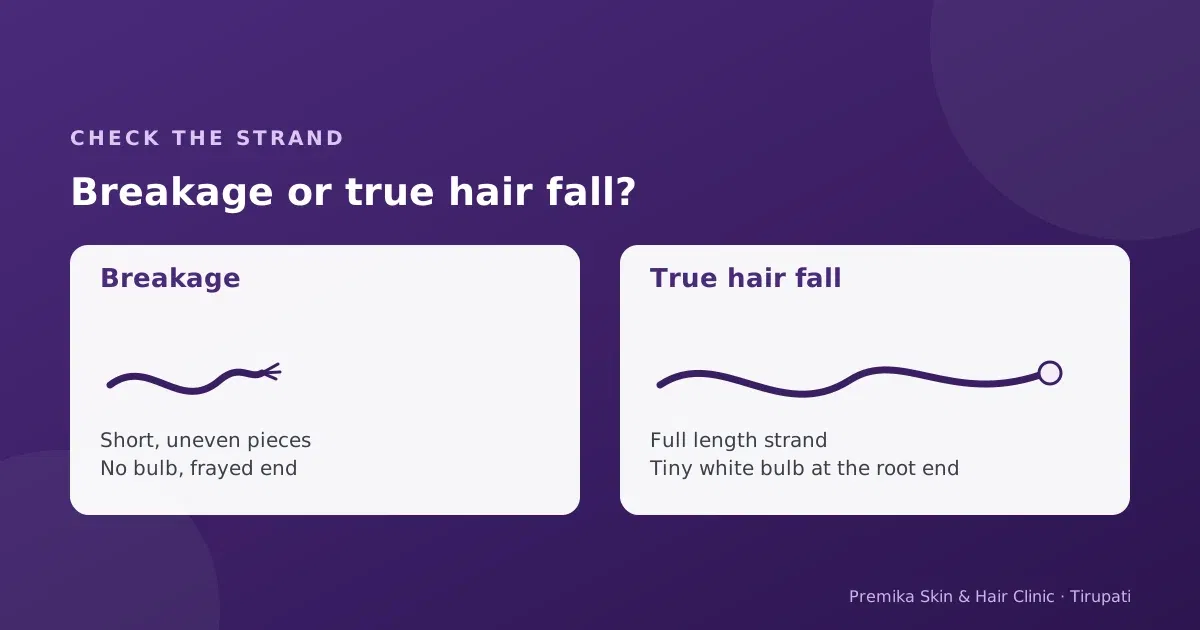
Breakage and hair fall look alike in the comb, but they are different problems. Pick up a few fallen strands and look at them closely.
| Breakage | True hair fall | |
|---|---|---|
| Length of strand | Short, uneven pieces | Full length |
| End of strand | No bulb, often frayed | Tiny white bulb at the root end |
| What you notice | Rough texture, split ends, frizz | Thinner ponytail, wider parting, visible scalp |
| Usual cause | Damage to the hair shaft | A problem at the root or inside the body |
← Swipe to see the full table →
Hard water is linked to breakage. If most of your fallen strands are full length with a white bulb, something else is going on.
The Real Causes Behind Hair Fall
Most hair fall starts inside the body, not in the bucket. The common causes we find are:
- Nutritional deficiencies: low iron, vitamin D, vitamin B12 or protein
- Thyroid problems: both underactive and overactive thyroid
- Hormonal changes: PCOS, childbirth, stopping contraceptive pills, menopause
- Recent illness: fever such as dengue or typhoid, surgery or a major infection, with hair fall starting two to three months later
- Stress and crash dieting: sudden weight loss or prolonged mental stress
- Pattern hair loss: the genetic type, seen in both men and women
- Scalp conditions: severe dandruff, fungal infection or psoriasis. See our general dermatology page.
- Hair practices: tight hairstyles, frequent heat styling, straightening and colouring
There is also a reason the borewell gets the blame so often. People usually switch to borewell water when they move to a new city for studies, work or marriage. The same move brings a new diet, new stress and poor sleep, and these are well-known triggers for hair fall. Read more in Gen Z and hair loss: why it is starting earlier.
How to Protect Your Hair from Borewell Water
You do not need to change your water source to protect your hair. A few simple habits reduce mineral build-up and breakage.
- Use a clarifying or chelating shampoo once a week. These remove mineral build-up. Use your regular mild shampoo on other wash days.
- Condition every time you wash. Apply from mid-length to the ends and leave it on for two to three minutes.
- Do the final rinse with filtered or RO water. Even one mug at the end washes away much of the mineral residue.
- Consider a water softener. It is the most reliable way to reduce hardness. Basic shower filters mainly remove chlorine and sediment, and do little for hardness.
- Be gentle with wet hair. Pat dry with a soft towel and use a wide-tooth comb. Wet hair breaks most easily.
- Oil lightly before washing. A little coconut oil 30 minutes before a wash helps protect the hair shaft.
- Limit heat and chemical treatments. Hair already stressed by hard water tolerates them poorly.
These steps improve texture and reduce breakage within a few weeks. They will not stop hair fall that comes from the root.
When to See a Dermatologist
See a dermatologist if hair care changes have not helped, or if you notice any of these:
- You are losing more than 100 strands a day
- Your parting is getting wider or your crown is thinning
- Your ponytail feels clearly thinner than before
- You see bald patches
- Your scalp is itchy, red, painful or scaly
- Hair fall has lasted more than three months
A consultation usually includes a scalp examination, a closer look at the hair roots and a few blood tests where needed. Once the cause is clear, most types of hair fall can be treated, and early treatment gives the best results.
The Bottom Line
Your borewell can damage the hair you have, but it is rarely the reason you are losing hair. Take care of your hair against hard water, and get persistent hair fall checked instead of only changing your water or your shampoo.
Hair fall that will not settle?
Book a hair and scalp assessment at Premika Skin & Hair Clinic, Tirupati, and find the real cause. Read more about our hair fall treatment.
Book a Consultation Call 80882 61834This article is for general awareness and does not replace a personal consultation.